Canonical output
Awaiting sign-offIntent ledger
- GOAL-001
- Manage lists and items in detail
- GOAL-002
- Collaborate with role-based access
- REQ-013
- Enforce viewer permissions
- REQ-022
- Enforce capacity and tier limits
SOLARIO / PLATFORM
Solario builds and transforms enterprise software through an explicit production lifecycle. Agents execute bounded work. Solario controls progression. Your organisation retains the executable software, its documentation and the full production record.
Every Workload moves through the same production lifecycle. Greenfield work begins with Intent. Brownfield programmes may begin with Discovery, then enter Intent with a reconstructed view of the current system.
Compile inputs into signed business goals and requirements.
Define architecture, interfaces, rules and delivery obligations.
Execute bounded work against the approved design.
Verify behaviour, quality and policy conformance independently.
Release approved, observable software into its target environment.
SOLARIO ZERO TRUST PRINCIPLE
The Governance Harness constrains what agents can do, verifies what they produce and keeps authority outside the generating workflow.
See the governance modelThe CLI makes the production lifecycle observable. Follow three moments from the existing Listify campaign and inspect the governed artefact produced at each step.
solario intent prd-listify-full
The CLI resolves the brief, user stories, test cases and design system. Solario Core turns them into canonical goals and requirements, then stops for Product Owner authority.
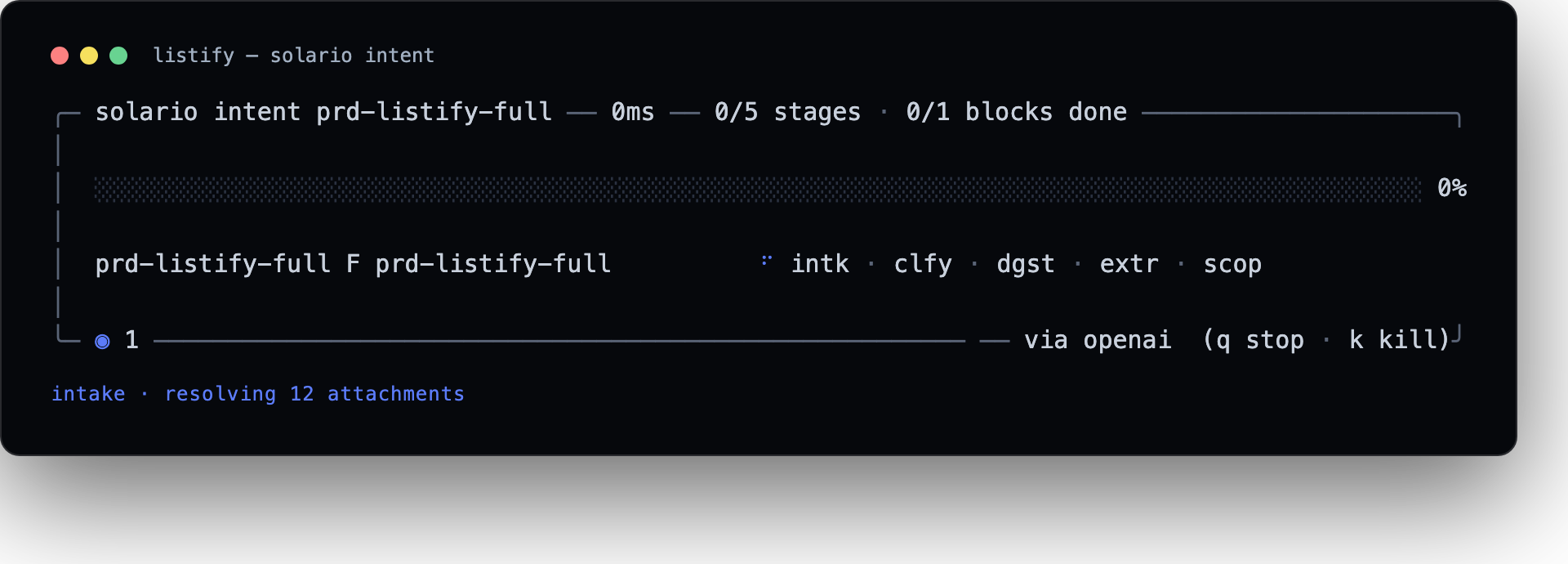
Canonical output
Awaiting sign-offsolario design prd-listify-full
Specifications, implementation plans and bounded tasks are generated against the Project architecture. Independent inspection produces the evidence required for a human design gate.
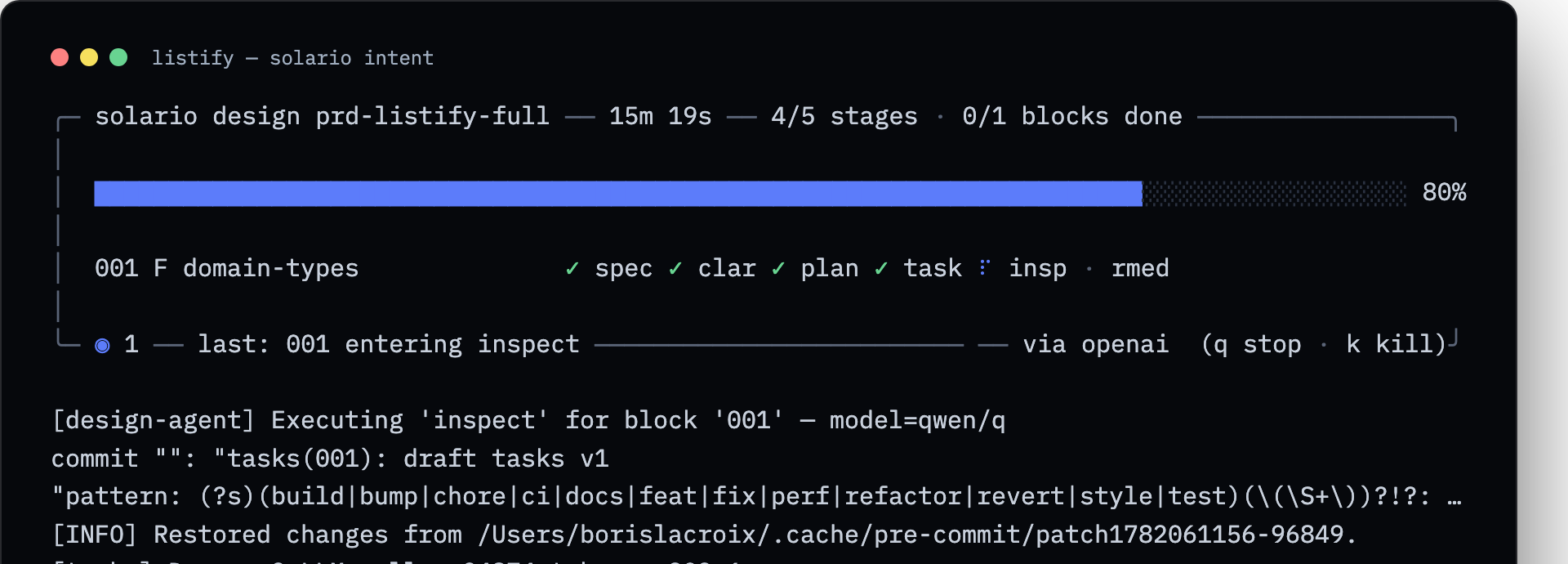
Design record
G3 · passsolario build prd-listify-full
Core resolves Block dependencies, dispatches bounded work and runs checks against the approved specification. Code, tests, commits, findings and verdicts remain attached to the run.
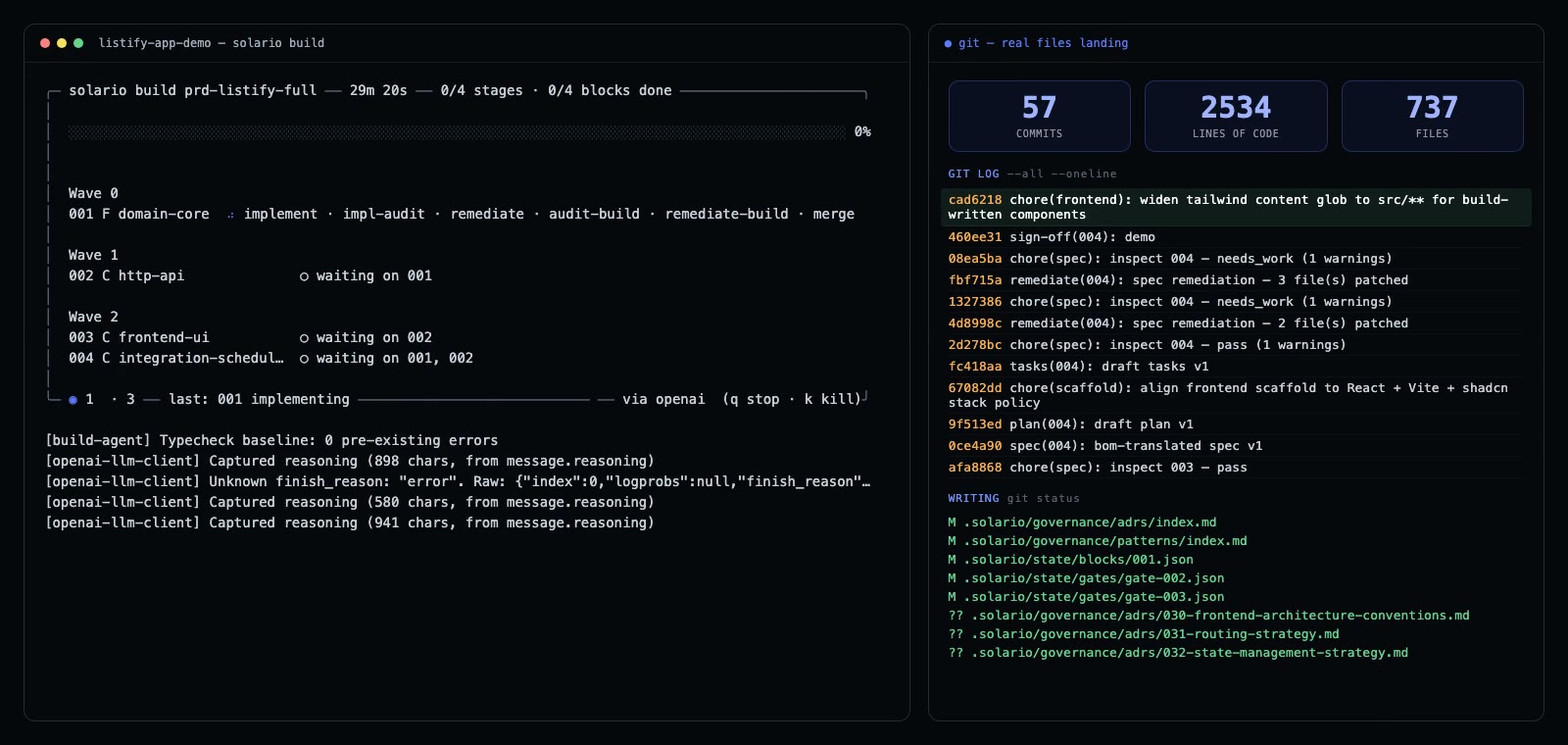
Production output
Checks cleanConsole and CLI are the operating surfaces. Core runs and governs the lifecycle. The AI SDK controls model access. The Artefact Store retains the production record.
Configure Projects and Workloads, inspect production runs, act at human checkpoints and retrieve the retained record.
Initialise governed Projects, execute phases locally or remotely, inspect progression and integrate the factory into CI.
03 / Execution and control engine
Core composes the Workload, orchestrates execution and owns every legal lifecycle transition. Agents perform bounded work inside the system. They do not define its rules or authorise progression.
Routes work through approved frontier and open-weight endpoints with one controlled model-access layer.
Retains immutable, classified artefacts with their Project, Workload origin and production provenance.
Solario retains more than the final code. Intent, specifications, decisions, evidence, repairs and releases remain linked so the next change begins from an inspectable system, not institutional memory.
SPRINT 0 / SOFTWARE DISCOVERY
In approximately two weeks, from EUR 20k, turn an existing system into a navigable retro-specification, architecture and code graph, and a set of prioritised transformation paths.